
What is Agentic AI and Why It’s the Next Big Thing?
11/21/20254 min read
Understanding Agentic AI: Definition and Concepts
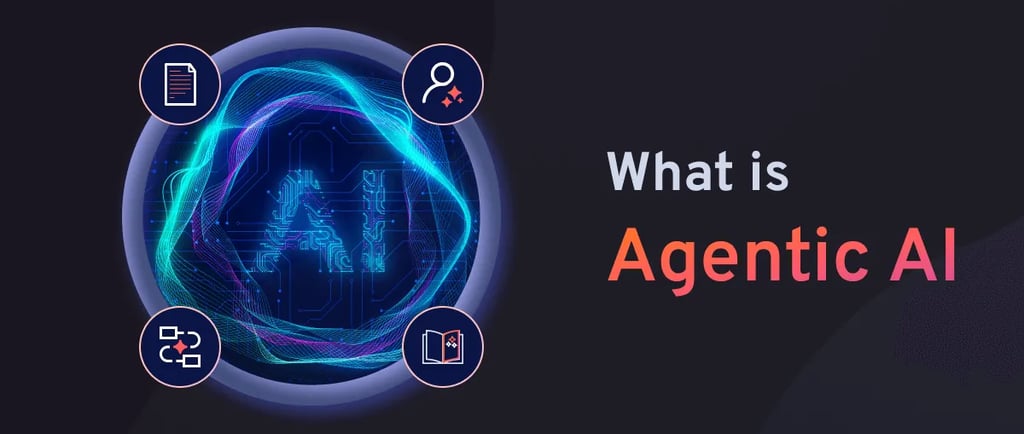
Agentic AI refers to artificial intelligence systems designed to operate autonomously, capable of making decisions and executing actions without human intervention. Unlike traditional AI, which primarily follows predefined algorithms and requires substantial human oversight, Agentic AI possesses a level of independence. This independence arises from its ability to perceive its environment, interpret complex data, and respond dynamically to varying situations. The core of Agentic AI lies in its agent-like characteristics; it perceives, reasons, and acts based on a rich understanding of context.
The conceptual framework of Agentic AI integrates elements of cognitive science, machine learning, and robotics. This convergence allows these systems to simulate intelligent behavior akin to human reasoning while carrying out tasks effectively in real-world scenarios. Such capabilities include the ability to recognize patterns, assess risks, and adapt to changing conditions. By leveraging advanced algorithms and large datasets, Agentic AI can optimize its decision-making processes, achieving more sophisticated outcomes than traditional AI systems.
The historical development of agentic technologies can be traced back to early explorations in autonomous systems and cybernetics. Over the years, advancements in computational power and data processing have propelled the evolution of these technologies, enabling AI agents to understand and interact more effectively with their surroundings. Foundational principles guiding Agentic AI include autonomy, adaptability, and goal-oriented behavior, which collectively empower these systems to function in diverse environments across various applications.
In summary, Agentic AI marks a significant shift in the landscape of artificial intelligence, emphasizing self-sufficiency and intelligent decision-making. It stands apart from conventional approaches, offering a more nuanced understanding of interaction and agency in the context of machine learning and automated systems.
The Advantages of Agentic AI: Transforming Industries
Agentic AI represents a transformational shift across multiple industries, offering a plethora of advantages that enhance operational efficiency and innovation. One of the most pronounced benefits is the significant reduction in human error. In sectors such as healthcare, AI systems can analyze medical data with greater precision than human practitioners. This culminates in better diagnostics and treatment recommendations, subsequently improving patient outcomes and minimizing risks associated with human oversight.
Moreover, Agentic AI empowers the finance sector by enabling real-time data processing and analysis. Financial institutions can utilize AI algorithms to detect fraudulent transactions with remarkable accuracy, thereby safeguarding consumer assets and enhancing customer trust. With rapid decision-making capabilities, risk assessments are conducted more thoroughly and swiftly, leading to increased efficiency in transaction processing and compliance measures.
In the manufacturing domain, the introduction of Agentic AI can streamline production lines through predictive maintenance and quality control. By utilizing sensors and data analytics, AI systems can predict equipment failures before they occur, thus reducing downtime and operational costs. Additionally, quality assurance processes can be enhanced through AI-driven inspections, ensuring that products meet established standards while minimizing waste.
Customer service is yet another area where Agentic AI is making significant strides. Advanced chatbots and virtual assistants trained with AI algorithms are now capable of addressing customer inquiries promptly and accurately. This not only enhances customer satisfaction but also allows human agents to focus on more complex issues. Ultimately, the introduction of Agentic AI fosters innovation by providing organizations with powerful tools that enable them to optimize processes, personalize services, and respond to market demands more effectively.
Challenges and Ethical Considerations in Agentic AI Implementation
The deployment of Agentic AI presents numerous challenges and ethical considerations that necessitate careful examination. One of the primary concerns revolves around data privacy. Agentic AI systems often rely on vast amounts of data to function effectively, raising questions about how this data is sourced, stored, and utilized. Ensuring that user consent is obtained and that data is anonymized can help mitigate privacy risks, but these processes must be robustly enforced to maintain public trust.
Transparency in decision-making is another critical aspect of Agentic AI. When AI systems make autonomous decisions, stakeholders may find it challenging to understand the rationale behind these choices. This opacity can lead to distrust among users if they perceive AI actions as arbitrary or biased. Establishing clear guidelines for the transparency of algorithms and decision-making processes is essential to foster stakeholder confidence in Agentic AI applications.
The potential for bias in AI systems poses an additional ethical challenge. Bias can enter AI models through skewed training data, leading to unfair outcomes that reinforce existing societal inequities. Addressing this issue requires ongoing efforts to audit and refine datasets and algorithms to ensure they are as impartial as possible. Additionally, multidisciplinary teams should be involved in the development process to bring diverse perspectives to AI applications and decision-making frameworks.
The regulatory landscape for Agentic AI is still evolving, and as such, organizations must navigate a complex array of laws and guidelines. Establishing ethical frameworks for the responsible use of Agentic AI is imperative to prevent misuse and promote accountability. This involves collaboration between technologists, ethicists, policymakers, and the public. As we advance in implementing Agentic AI, these considerations will shape not only our technological landscape but also our societal norms regarding innovation and ethics.
The Future of Agentic AI: Trends and Predictions
The landscape of Agentic AI is rapidly evolving, driven by advancements in technology and increasing demands for automated solutions across various sectors. Future trends suggest that Agentic AI will become more integrated into everyday life, enhancing not only efficiency but also user experience in numerous applications, from personal assistants to smart home devices. This pervasive presence of Agentic AI is expected to result in a more intuitive interaction between humans and machines, blurring the lines between traditional software and intelligent agents capable of learning and adapting.
Predictions from industry experts indicate that the development of Agentic AI will significantly contribute to economic growth. By automating routine tasks, businesses can allocate resources more effectively, driving productivity and innovation. This transition is poised to create new job opportunities centered around AI maintenance, supervision, and ethical governance, counteracting fears related to job displacement. Furthermore, sectors such as healthcare, finance, and education are set to benefit from tailored solutions driven by Agentic AI, which will enhance decision-making processes and improve service delivery.
Ongoing research and development efforts are also critical to refining the capabilities of Agentic AI. Scholars and technologists are focusing on improving the ethical frameworks that guide AI development, ensuring that these intelligent systems are transparent and accountable. Collaboration between governments, academia, and industry is essential to establishing regulatory standards that foster innovation while mitigating potential risks associated with Agentic AI. As these initiatives progress, stakeholders will need to remain vigilant about the societal impact of AI technology and prioritize human-centric approaches in its implementation.
In conclusion, the future of Agentic AI holds considerable promise, positioning it as a transformative force across multiple domains. By leveraging emerging trends and insights, we can anticipate a world where Agentic AI not only enhances daily life but also drives economic advancement and societal progress.
EasyHacks.Tech
Daily IT Support Blogs & Insights
© 2025 EasyHacks.Tech | All Rights Reserved